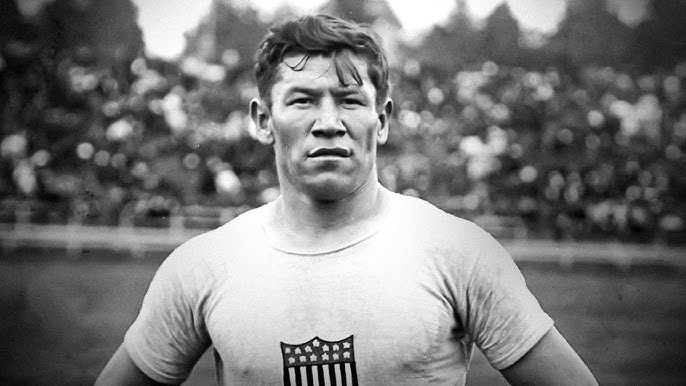
Jim Thorpe was one of the most remarkable athletes in American sports history. He competed at the highest level in several sports, including track and field, football, baseball, and basketball.
What made Thorpe extraordinary was not simply the number of sports he played. He was able to compete at an elite level across disciplines that required very different physical skills.
His life, however, was more complicated than his athletic achievements. Thorpe faced discrimination, financial difficulties, and a controversial loss of his Olympic amateur status. Decades after his death, his Olympic legacy was formally restored.
This Jim Thorpe athlete biography explores his early life, athletic career, Olympic achievements, professional sports career, personal challenges, and lasting legacy.
Who Was Jim Thorpe?
Jim Thorpe was an American athlete who became famous for competing successfully in multiple sports.
He was born May 28, 1887, near Prague, in what was then Indian Territory and is now Oklahoma. His birth name and identity are connected to his Native American heritage, and he was associated with the Sac and Fox Nation.
Thorpe became internationally famous after winning two gold medals at the 1912 Olympic Games in Stockholm, Sweden.
He won the:
- Pentathlon
- Decathlon
His performance in the decathlon was particularly impressive because he won by a large margin and demonstrated exceptional ability across ten different events.
Jim Thorpe’s Early Life
Thorpe grew up in Oklahoma at a time when opportunities for Native American children were severely limited.
He attended the Carlisle Indian Industrial School in Pennsylvania, an institution that sought to assimilate Native American children into mainstream American society.
Carlisle would become an important part of Thorpe’s athletic development.
There, he came under the influence of football coach Glenn Scobey “Pop” Warner, one of the most influential coaches in early American football.
Thorpe quickly demonstrated that he had extraordinary natural athletic ability.
How Did Jim Thorpe Become an Athlete?
Thorpe reportedly showed unusual physical ability from a young age.
At Carlisle, he competed in track and field and football and eventually became one of the school’s most celebrated athletes.
His abilities were not limited to one event or sport.
He could:
- Run quickly
- Jump exceptionally well
- Throw with power
- Play football
- Hit a baseball
- Compete in multiple track events
This versatility became the defining feature of his career.
Jim Thorpe and the 1912 Olympics
The 1912 Olympic Games in Stockholm were the event that turned Thorpe into an international sporting sensation.
He competed in the pentathlon and decathlon, two demanding multi-event competitions.
Winning the Pentathlon
Thorpe won the pentathlon with a dominant performance.
The competition involved five events, requiring athletes to demonstrate speed, endurance, jumping ability, and throwing skills.
Thorpe’s versatility allowed him to excel across the different disciplines.
Winning the Decathlon
Thorpe also won the decathlon.
The event consisted of ten track and field competitions spread across the Olympic program.
Thorpe’s performance was so impressive that Sweden’s King Gustav V reportedly praised him as the greatest athlete in the world.
The 1912 Olympics established Thorpe as one of the most versatile athletes of his generation.
What Sports Did Jim Thorpe Play?
One of the most remarkable things about Thorpe was the number of sports in which he competed.
His major sports included:
Track and Field
Track and field produced his greatest international achievement.
His Olympic victories in the pentathlon and decathlon made him famous around the world.
American Football
Thorpe became a major football star.
He played for Carlisle and later competed professionally.
His combination of speed, strength, kicking ability, and running made him one of the most dangerous players of his era.
Baseball
Thorpe also played professional baseball.
He spent time in Major League Baseball with teams including the New York Giants, Cincinnati Reds, and Boston Braves.
His baseball career was not as dominant as his football career, but his ability to compete professionally in another major sport was remarkable.
Basketball
Thorpe was also associated with professional basketball.
He played with teams during the early development of professional basketball in the United States.
Because professional sports were less organized in his era than they are today, records of some parts of his basketball career are incomplete.
Jim Thorpe’s Football Career
Football became one of Thorpe’s most important professional sports.
He played for the Canton Bulldogs, one of the strongest professional football teams of the period.
Thorpe’s presence helped draw attention to professional football at a time when the sport was still developing.
He later became associated with the National Football League, which was founded in 1920 as the American Professional Football Association before adopting the NFL name in 1922.
Thorpe served as the league’s first president, although the league’s early structure was very different from today’s NFL.
Why Was Jim Thorpe’s Olympic Status Taken Away?
Thorpe’s Olympic career became controversial after it was discovered that he had played semi-professional baseball before the 1912 Olympics.
At the time, Olympic rules regarding amateur status were much stricter than modern rules.
Thorpe had received money for playing baseball, which was considered a violation of amateur eligibility rules.
As a result, his Olympic medals were taken away in 1913.
The decision became one of the most controversial episodes in Olympic history.
Did Jim Thorpe Get His Olympic Medals Back?
Yes—but not during his lifetime.
Thorpe died in 1953, decades before his Olympic status was restored.
In 1982, the International Olympic Committee recognized Thorpe as a co-champion of both the pentathlon and decathlon and restored his medals to his family.
However, the story did not end there.
In 2022, the IOC formally restored Thorpe as the sole Olympic champion in both events after reviewing the historical circumstances surrounding his disqualification.
The restoration helped correct a long-standing injustice associated with his Olympic record.
Jim Thorpe’s Challenges Outside Sports
Thorpe’s athletic achievements often overshadow the difficulties he experienced outside competition.
He lived during a period when Native Americans faced widespread discrimination and unequal opportunities.
After his athletic career declined, Thorpe struggled financially.
He worked in various jobs and made appearances connected to his fame.
His later years were considerably less glamorous than his Olympic victories might suggest.
Jim Thorpe’s Personal Life
Thorpe married several times and had a large family.
His personal life was affected by the instability that followed his athletic career.
He also struggled financially during parts of his later life.
Despite these difficulties, his reputation as one of America’s greatest athletes continued to grow.
When Did Jim Thorpe Die?
Jim Thorpe died on March 28, 1953, in Lomita, California.
He was 64 years old.
His death marked the end of the life of one of the most versatile athletes the United States had ever produced.
However, his athletic legacy continued to grow after his death.
Jim Thorpe’s Legacy
Thorpe’s legacy extends far beyond his Olympic medals.
He became a symbol of athletic versatility and Native American achievement.
His ability to compete professionally in multiple sports is particularly remarkable when considered in the context of his era.
Today, Thorpe is remembered for achievements including:
- Two Olympic gold medals from the 1912 Games
- Exceptional performances in the pentathlon and decathlon
- A successful football career
- Professional baseball experience
- Contributions to early professional football
- His role in the early history of the NFL
- His status as one of the greatest multi-sport athletes in history
Jim Thorpe and Native American History
Thorpe’s story is also important because of his Native American heritage.
He became one of the most internationally recognized Native American athletes of the early 20th century.
His success challenged many of the racial stereotypes that were common during his lifetime.
Today, his name remains closely associated with Native American athletic achievement.
Jim Thorpe’s Records and Athletic Reputation
Comparing athletes from different eras can be difficult because training methods, equipment, competition formats, and professional sports structures have changed dramatically.
Nevertheless, Thorpe remains regularly cited among the greatest athletes in American history.
His uniqueness comes from the sheer variety of sports and events in which he competed successfully.
Modern athletes often specialize in a single sport or even a single position. Thorpe competed at a high level across several sports requiring completely different skill sets.
What Made Jim Thorpe So Special?
Several characteristics made Thorpe exceptional.
Versatility
His ability to compete in running, jumping, throwing, football, baseball, and other sports was extraordinary.
Natural Athletic Ability
Thorpe possessed a rare combination of speed, strength, coordination, endurance, and explosiveness.
Competitive Ability
He was not merely participating in different sports. He was winning important competitions against elite athletes.
Adaptability
Thorpe repeatedly moved between sports and learned the skills required to compete at a high level.
Frequently Asked Questions About Jim Thorpe
What was Jim Thorpe famous for?
Jim Thorpe was famous for being an exceptional multi-sport athlete and for winning Olympic gold medals in the pentathlon and decathlon at the 1912 Olympics.
How many Olympic gold medals did Jim Thorpe win?
Thorpe won two Olympic gold medals in 1912—one in the pentathlon and one in the decathlon.
What sports did Jim Thorpe play?
He competed in track and field, American football, baseball, and basketball, among other athletic activities.
Did Jim Thorpe play in the NFL?
Yes. Thorpe played professional football and was involved in the early history of the NFL.
Why were Jim Thorpe’s Olympic medals taken away?
His medals were taken away after officials determined that he had violated the Olympic amateurism rules by receiving payment for playing semi-professional baseball before the 1912 Games.
Did Jim Thorpe get his medals back?
Yes. The IOC restored his status as Olympic champion in 2022, recognizing him as the sole champion of the 1912 pentathlon and decathlon.
How old was Jim Thorpe when he died?
Jim Thorpe was 64 years old when he died in 1953.
Final Thoughts
Jim Thorpe’s story is much bigger than a list of athletic achievements.
He won Olympic gold medals, played professional football and baseball, competed in multiple sports, and helped shape the early history of professional football.
At the same time, his career was affected by discrimination, financial difficulties, and a controversial Olympic decision that took decades to correct.
His Olympic status was ultimately restored, but his greatest legacy may be the example he left of what an extraordinarily versatile athlete could accomplish.
More than a century after his Olympic triumphs, Jim Thorpe remains one of the most fascinating and accomplished athletes in American sports history.